
Across Reddit and other travel forums, I frequently see confusion surrounding the Schengen Zone’s 90/180 day rule. I too used to be confused how the 90 day limits were calculated. Travellers often ask variations of the same question:
If I stay in the Schengen Zone for a while, leave for a couple of months, can I then return for X number of days?
I use these questions as opportunities to deepen my understanding of Schengen stay rules and to ensure that the Melimundo Schengen Calculator is as accurate as possible. By testing real-world scenarios against the European Official calculator and ChatGPT, I increase confidence that Melimundo’s output is both correct and easy to understand.
In this case study, this Redditor's question caught my attention as it's what I was trying to do when visiting Spain: maximising my stay. Specifically:
- They planned to stay in the Schengen Zone for 50 days.
- After that, they would leave for 2–3 months, spending time in non-Schengen countries like the UK or Ireland (as of 2025). But they were unsure of long they had to leave exactly.
- Finally, they wanted to return to the Schengen Zone and maximise a 90-day stay.
This scenario is a common question for long-term travellers: how to stay in Europe for as long as legally possible, even if it means hopping between Schengen and non-Schengen countries.
Can a traveller return to the Schengen Zone after a 2–3 month break and stay for another 90 days?
Yes, the traveller can return to the Schengen Zone after a break — but only after 90 full days outside. This is because the Schengen rule allows a stay of up to 90 days within any rolling 180-day period.
If the traveller returns before completing a 90-day break, they risk overstaying. That’s because any time spent in the Schengen Zone during the previous 180 days still counts against the limit.
In simple terms:
- You can stay 90 days in, but then you must spend 90 days out before re-entering for another long stay.
Example of an 50 day trip, with a stay in the UK, and returning for 90 full days
To test this, I created real-world dates:
- 23rd April 2025 – 11th June 2025: 50 days spent in the Schengen Zone.
- 10th September 2025 – 8th December 2025: 90 days spent in the Schengen Zone.
Between 12th June 2025 – 9th September 2025, the traveller must remain outside the Schengen Zone for at least 90 days to comply with the 90/180 rule.
Melimundo Schengen Calculator
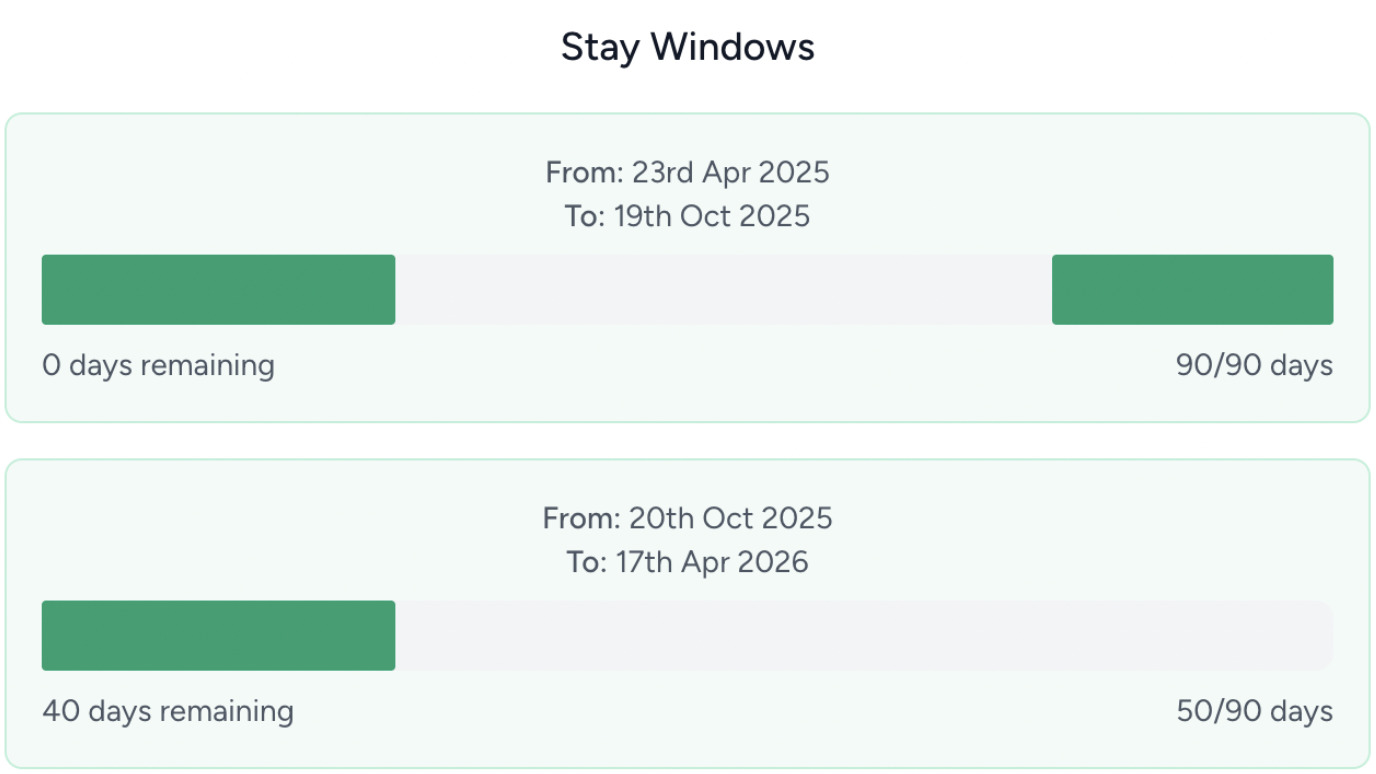
Two windows were calculated with no breaches:
Window 1:
- Covered the entire first 50 days and part of the 90-day break.
- Lasted from 23rd April 2025 to 19th October 2025.
Window 2:
- Covered the remaining part of the 90-day break.
- Lasted from 20th October 2025 to 17th April 2026.
Melimundo will look at all possible windows to see if there's breaches. If there are no breaches, it'll use the first set of windows that makes sense in terms of no breaches.
Comparing Melimundo's Calculator with the Official Schengen Calculator
To ensure that my calculator was accurate, I compared it against the EU Official Schengen Calculator. Even though I display the information differently and visualise the trips in a more user-friendly way, the key goal is that both calculators provide the same results.
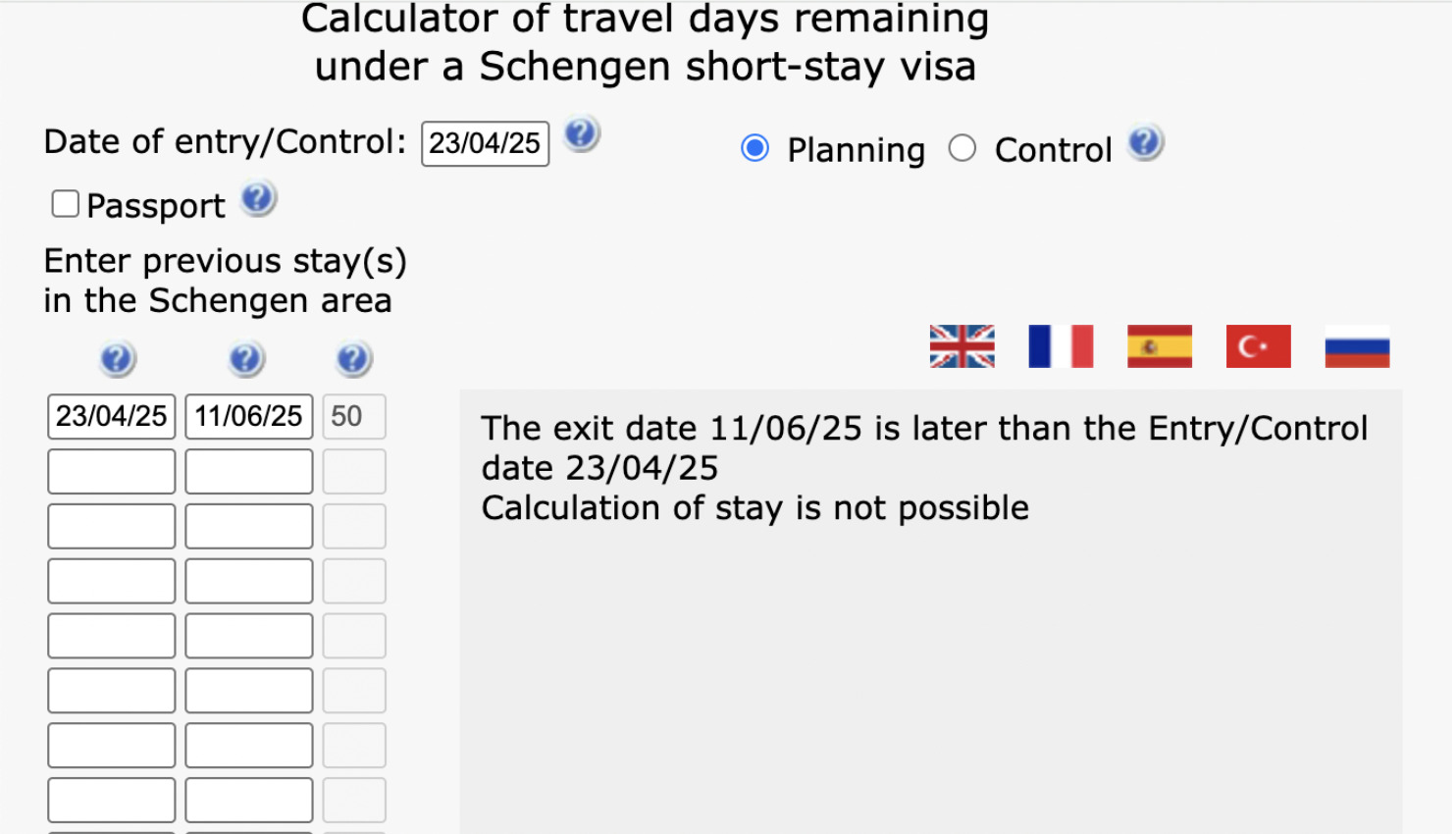
Interestingly, when I tried to calculate the trip using the dates from 2025 (as described earlier), I couldn't get it to work on the official EU calculator. For some reason, I had to switch to using 2024 dates to get the calculation to process correctly.
When I did use the 2024 year instead of 2025, and used the control option, it did rightly determine no breaches were made. It said more specifically:
No overstay in the registration period. Possible stay until 02/08/25 For holder of a short stay visa, remember to check the number of days on the visa sticker or in the VIS.
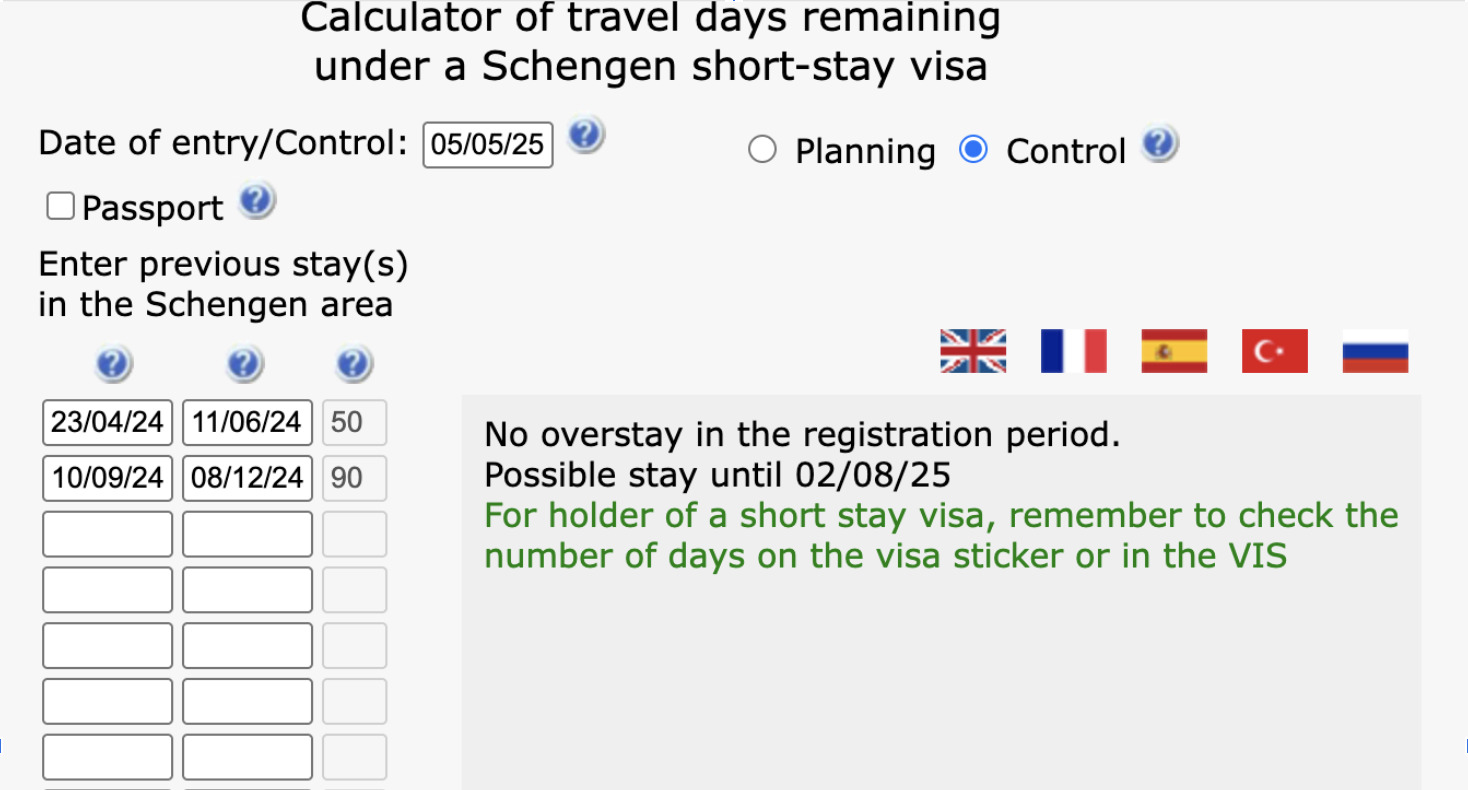
As for what "Possible stay until 02/08/25 means", I don't understand yet as I should be able to return a lot sooner than that. But so far, I'm happy the results are the same.
Testing a breach example, returning 89 days after the first 50-day trip.
Now what would happen, if we returned 89 days after the first 50-day trip.
To test breaches, I adjusted the dates to be:
- 23rd April 2025 - 11th June 2025. 50 days.
- 9th September 2025 - 7th December 2025. 90 days, but starting and one day earlier.
Reporting breaches in the Melimundo Schengen Calculator
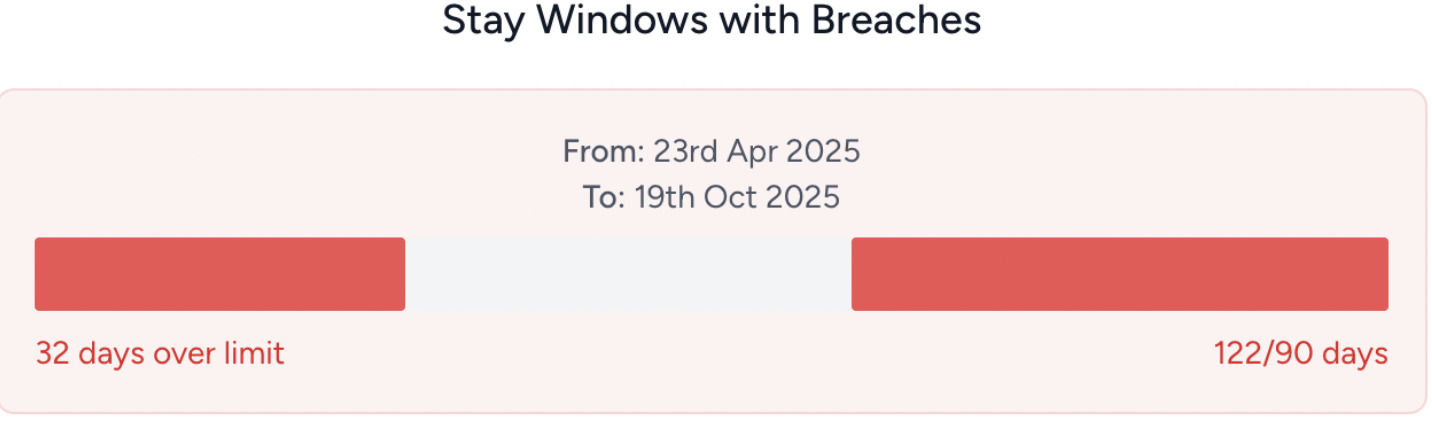
The calculator visualised all breached dates. I converted the histogram into a table. Notice how the breach was over only by 1 day for every single possible rolling-window, simply by returning a day too early:
| From Date | To Date | Days Over Limit | Breach Info |
|---|---|---|---|
| 23rd Apr 2025 | 19th Oct 2025 | 1 day | 91/90 days |
| 24th Apr 2025 | 20th Oct 2025 | 1 day | 91/90 days |
| 25th Apr 2025 | 21st Oct 2025 | 1 day | 91/90 days |
| 26th Apr 2025 | 22nd Oct 2025 | 1 day | 91/90 days |
| 27th Apr 2025 | 23rd Oct 2025 | 1 day | 91/90 days |
| 28th Apr 2025 | 24th Oct 2025 | 1 day | 91/90 days |
| 29th Apr 2025 | 25th Oct 2025 | 1 day | 91/90 days |
| 30th Apr 2025 | 26th Oct 2025 | 1 day | 91/90 days |
| 1st May 2025 | 27th Oct 2025 | 1 day | 91/90 days |
| 2nd May 2025 | 28th Oct 2025 | 1 day | 91/90 days |
| 3rd May 2025 | 29th Oct 2025 | 1 day | 91/90 days |
| 4th May 2025 | 30th Oct 2025 | 1 day | 91/90 days |
| 5th May 2025 | 31st Oct 2025 | 1 day | 91/90 days |
| 6th May 2025 | 1st Nov 2025 | 1 day | 91/90 days |
| 7th May 2025 | 2nd Nov 2025 | 1 day | 91/90 days |
| 8th May 2025 | 3rd Nov 2025 | 1 day | 91/90 days |
| 9th May 2025 | 4th Nov 2025 | 1 day | 91/90 days |
| 10th May 2025 | 5th Nov 2025 | 1 day | 91/90 days |
| 11th May 2025 | 6th Nov 2025 | 1 day | 91/90 days |
| 12th May 2025 | 7th Nov 2025 | 1 day | 91/90 days |
| 13th May 2025 | 8th Nov 2025 | 1 day | 91/90 days |
| 14th May 2025 | 9th Nov 2025 | 1 day | 91/90 days |
| 15th May 2025 | 10th Nov 2025 | 1 day | 91/90 days |
| 16th May 2025 | 11th Nov 2025 | 1 day | 91/90 days |
| 17th May 2025 | 12th Nov 2025 | 1 day | 91/90 days |
| 18th May 2025 | 13th Nov 2025 | 1 day | 91/90 days |
| 19th May 2025 | 14th Nov 2025 | 1 day | 91/90 days |
| 20th May 2025 | 15th Nov 2025 | 1 day | 91/90 days |
| 21st May 2025 | 16th Nov 2025 | 1 day | 91/90 days |
| 22nd May 2025 | 17th Nov 2025 | 1 day | 91/90 days |
| 23rd May 2025 | 18th Nov 2025 | 1 day | 91/90 days |
| 24th May 2025 | 19th Nov 2025 | 1 day | 91/90 days |
| 25th May 2025 | 20th Nov 2025 | 1 day | 91/90 days |
| 26th May 2025 | 21st Nov 2025 | 1 day | 91/90 days |
| 27th May 2025 | 22nd Nov 2025 | 1 day | 91/90 days |
| 28th May 2025 | 23rd Nov 2025 | 1 day | 91/90 days |
| 29th May 2025 | 24th Nov 2025 | 1 day | 91/90 days |
| 30th May 2025 | 25th Nov 2025 | 1 day | 91/90 days |
| 31st May 2025 | 26th Nov 2025 | 1 day | 91/90 days |
| 1st Jun 2025 | 27th Nov 2025 | 1 day | 91/90 days |
| 2nd Jun 2025 | 28th Nov 2025 | 1 day | 91/90 days |
| 3rd Jun 2025 | 29th Nov 2025 | 1 day | 91/90 days |
| 4th Jun 2025 | 30th Nov 2025 | 1 day | 91/90 days |
| 5th Jun 2025 | 1st Dec 2025 | 1 day | 91/90 days |
| 6th Jun 2025 | 2nd Dec 2025 | 1 day | 91/90 days |
| 7th Jun 2025 | 3rd Dec 2025 | 1 day | 91/90 days |
| 8th Jun 2025 | 4th Dec 2025 | 1 day | 91/90 days |
| 9th Jun 2025 | 5th Dec 2025 | 1 day | 91/90 days |
| 10th Jun 2025 | 6th Dec 2025 | 1 day | 91/90 days |
| 11th Jun 2025 | 7th Dec 2025 | 1 day | 91/90 days |
Now apologies for the verbose table, but it's to highlight what the calculator did, to double check.
One thing that could be improved here to highlight, which dates exactly are included in the breach, but in the Melimundo calculator, the breaches are visualised, so maybe that's sufficient.
Comparing the Overstay Example with the Official Calculator
Of course, I wanted to compare the breached scenario again with the Official calculator.
Here's what it said:
Days of stay in the 180-days period from 11/06/24 to 07/12/24: 91 day(s)
Overstay in the period from 19/10/24 to 07/12/24 (50 days)
The official calculator highlighted the 91 days overstay, but chose to use brevity by only sharing one window. While it’s not as clear in terms of all the windows that were breached, this level of detail may not be necessary if you’re simply trying to find out whether you're breaking the overstay rules.
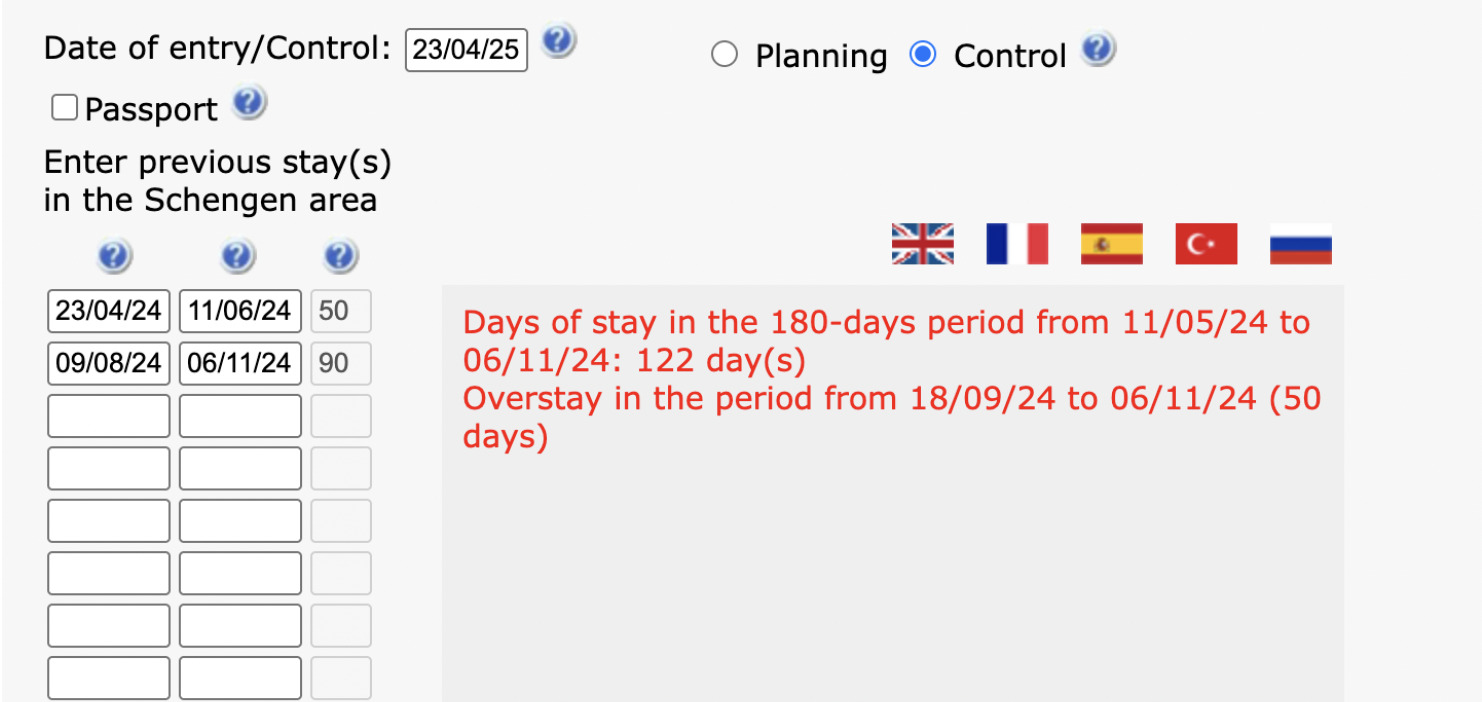
Again, I could not use the 2025 dates in the official calculator, maybe cause the dates are partly in the future. But I'll try to discover why for next time.
Conclusion
After testing it against the official EU calculator, I’m confident in the accuracy of the Melimundo Schengen Calculator.
What really makes a difference is the visual timeline—it clearly shows how your days are used and highlights the exact dates you're over if you breach the 90/180 rule. This makes it much easier to plan ahead and avoid overstaying.
I also appreciate how it simplifies what can otherwise feel like a complicated rule. It gives you a clear picture of where you stand and makes preparation straightforward. While there’s room for even more useful features in the future, it’s already proving to be a helpful tool.